Most performance marketers make the mistake of measuring success through a binary lens: either a sale happened, or it didn't. This tunnel vision creates a "data starvation" problem. If your landing page only generates 10 macro conversions a month, you lack the statistical significance required to run a valid A/B test. You are guessing, not optimizing.
The distinction between micro and macro conversions isn't just academic; it determines how you allocate your ad spend and where you point your developers. Macro conversions represent the ultimate business goal—the revenue. Micro conversions represent the user intent and friction points along the way. To scale a funnel, you must treat micro conversions as the leading indicators that predict macro success. Understanding these relationships is key, which starts with properly setting up conversion tracking for both types.
Macro Conversions: The Bottom-Line Metrics
Macro conversions are the primary actions that directly impact your P&L. These are the "big wins" that justify your marketing budget. In a B2B context, this is usually a qualified lead or a booked demo. In e-commerce, it is a completed transaction.
Best for: Calculating ROAS, determining customer acquisition cost (CAC), and reporting to stakeholders.
While macro conversions are the most important metric for the business, they are often the least useful for day-to-day optimization. Because they occur at the end of the funnel, they don't tell you why a user dropped off; they only tell you that they did. Relying solely on macro data is like trying to coach a basketball team by only looking at the final score without watching the game film.
Micro Conversions: The Leading Indicators of Intent
Micro conversions are the smaller steps a user takes toward the macro goal. They are divided into two categories: process milestones and secondary actions.
- Process Milestones: Steps that are part of the linear path to purchase, such as "Add to Cart," "Start Free Trial," or "Step 1 of 4 in a Form."
- Secondary Actions: Behaviors that indicate high interest but aren't mandatory, such as downloading a whitepaper, watching 50% of a product video, or spending more than three minutes on a pricing page.
Best for: Identifying funnel friction, warming up retargeting audiences, and providing enough data points for rapid A/B testing.
If your macro conversion rate is 2%, you are ignoring the behavior of the other 98%. Micro conversions allow you to segment that 98% into "window shoppers" and "high-intent prospects." A user who visits your shipping policy page and then your pricing page is significantly more valuable than a user who bounces from the homepage after three seconds. This detailed understanding is only possible through segmenting traffic sources and analyzing their unique journeys.
Pro Tip: Do not optimize for micro conversions that have no correlation with your macro goal. If you increase "Newsletter Signups" by 50% but your "Sales" remain flat, you have likely attracted low-quality traffic or created a "lead magnet" that doesn't align with your core product.
The Statistical Advantage of Micro-Conversion Tracking
The primary reason to prioritize micro conversions in your CRO (Conversion Rate Optimization) workflow is speed. To reach a 95% confidence level in an A/B test, you need a specific volume of conversions. If you are testing a new headline on a high-ticket SaaS landing page that gets 5 sales a month, your test might need to run for a year to reach significance.
However, if you track "Click to Open Demo Video" as a micro conversion, and that action happens 200 times a month, you can reach a statistically significant conclusion in weeks. By optimizing for the micro-step that correlates most strongly with the sale, you accelerate your iteration cycle.
Mapping the Relationship: The Conversion Hierarchy
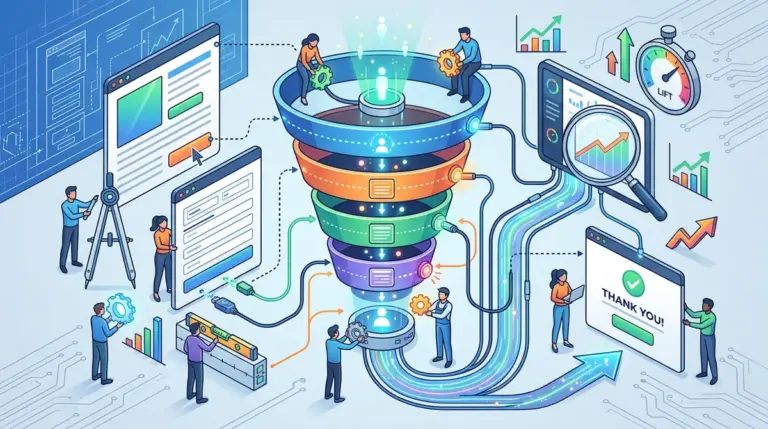
To use these metrics effectively, you must build a conversion hierarchy. This maps the user journey from the first touchpoint to the final transaction. For a standard B2B SaaS funnel, the hierarchy might look like this:
Level 1 (Low Intent): Scroll depth of 50%, viewing the features page, or clicking an accordion FAQ.
Level 2 (Medium Intent): Downloading a case study, using an interactive ROI calculator, or staying on site for over 2 minutes.
Level 3 (High Intent/Micro): Clicking the "Get Started" button, visiting the "Contact Us" page, or starting the sign-up flow.
Level 4 (Macro): Completing the sign-up, verifying the email, and becoming a paying subscriber.
By monitoring the "drop-off" between these levels, you can pinpoint exactly where the friction exists. If Level 2 to Level 3 has a massive cliff, your middle-of-the-funnel content isn't persuasive enough to drive the next action.
When to Pivot Your Focus
The weight you give to micro vs. macro conversions should shift based on your site's maturity and traffic volume.
For new sites or low-traffic landing pages, micro conversions are your primary source of truth. You need the volume to understand if your messaging resonates. For high-traffic enterprise sites, you can afford to ignore some micro-data and focus strictly on optimizing for macro-revenue, as you already have the volume to support those tests.
Warning: Be wary of "False Positives." A change that increases a micro conversion (like making a "Download PDF" button huge and bright) can sometimes cannibalize the macro conversion (by distracting users from the "Buy Now" button). Always monitor the impact on the final goal.
Calibrating Your Measurement Strategy
To move beyond basic tracking, you must assign a proxy value to your micro conversions. If you know that 10% of people who download your whitepaper eventually spend $1,000, then every whitepaper download is worth $100 to your business. This allows you to calculate a "Predicted Revenue" for your campaigns long before the actual sales close.
Use event tracking in your analytics suite to capture these moments. Don't just track page views; track clicks on outbound links, form field interactions, and video engagement. This granular data is what separates a high-performing funnel from a stagnant one.
FAQs
Should I set micro conversions as primary goals in Google Ads?
Generally, no. You should keep your macro conversion (the sale or lead) as the primary goal for bidding optimization. However, you can use micro conversions as "Observation" goals or use them to build "High Intent" remarketing audiences for more aggressive bidding.
Can too many micro conversions hurt my macro conversion rate?
Yes. This is known as "Choice Overload" or "Friction." If you give a user ten different things to do (download this, watch that, sign up here), they may do none of them. Every micro conversion offered should be a stepping stone toward the macro goal, not a distraction from it.
What is the most important micro conversion to track?
The "High-Intent Step" is usually the most critical. This is the final action a user takes before the macro conversion—such as clicking "Proceed to Checkout" or "View Pricing." This metric has the highest correlation with revenue and provides the most actionable data for CRO.