

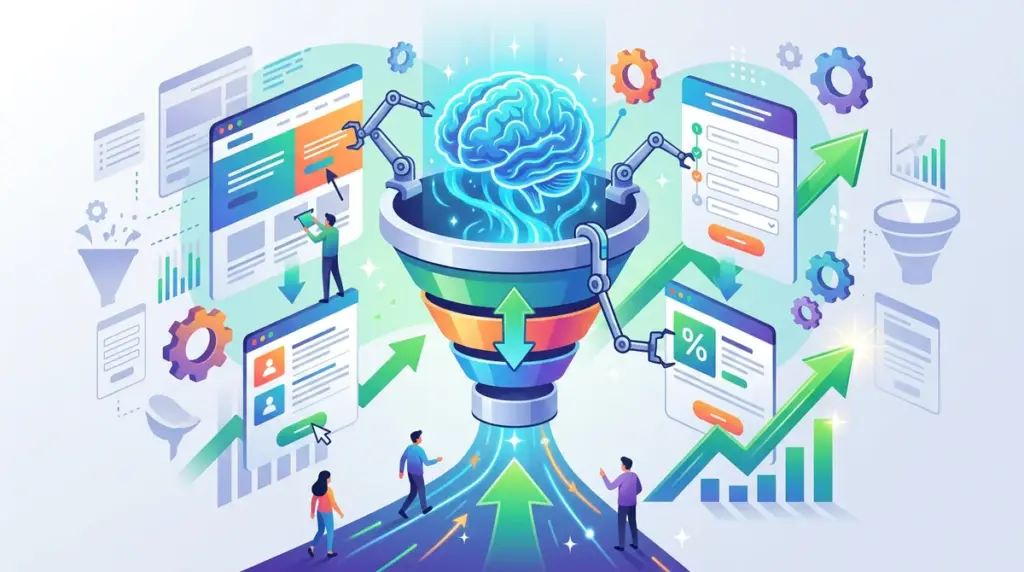
The primary bottleneck in conversion rate optimization (CRO) is rarely a lack of ideas; it is the speed of execution. Traditional workflows stall during the transition from raw data collection to actionable hypothesis. For most teams, analyzing 500 post-purchase survey responses or manually auditing 20 landing pages for visual hierarchy issues takes weeks. AI narrows this gap by acting as a high-speed synthesis engine, allowing optimizers to move from data to deployment in hours rather than days.
Effective AI integration in CRO does not replace the strategist. Instead, it automates the "grunt work" of pattern recognition, copy iteration, and technical script generation. By leveraging large language models (LLMs) and vision-capable tools, agencies can increase their testing velocity—the single most important metric for long-term conversion lift.
Automating Qualitative Data Synthesis
Qualitative data is the most valuable asset in a CRO audit, yet it is often the most underutilized because it is unstructured. Analyzing heatmaps, session recordings, and open-ended survey results is labor-intensive. AI excels at categorizing these data points into friction themes.
Best for: Reducing the time spent on manual sentiment analysis and thematic coding of customer feedback.
Instead of reading every individual survey response, you can feed anonymized transcripts into an LLM to identify the "Job to be Done" (JTBD). By prompting the model to "identify the top five recurring objections mentioned by users who did not complete the checkout," you transform a spreadsheet of 1,000 rows into a prioritized list of UX fixes. This allows the strategist to focus on solving the problem rather than finding it.
- Sentiment Mapping: Automatically tag customer support tickets to find where technical bugs overlap with user frustration.
- Clarity Audits: Use vision models to scan landing pages and identify where the "above-the-fold" content fails to answer what the product is and who it is for within five seconds.
- Transcript Summarization: Convert hours of user testing videos into concise bullet points highlighting specific navigation hurdles.
Generating High-Velocity Copy Variants
Copywriting is the highest-leverage lever in CRO. Small changes in headline framing or CTA urgency often yield higher lifts than changing button colors. AI allows for the rapid generation of variants based on established persuasion frameworks like PAS (Problem-Agitation-Solution) or AIDA (Attention-Interest-Desire-Action).
The goal is not to let the AI write the final copy, but to generate a "challenger" set for an A/B test. For example, if your control headline is feature-focused, you can prompt an AI to rewrite it using a "loss aversion" angle or a "social proof" angle. This ensures that your tests are challenging the underlying psychological trigger, not just the word choice.
Warning: Never allow AI to generate copy without a human fact-check. LLMs frequently hallucinate specific product capabilities or fabricate statistics to make a marketing claim sound more persuasive. Always verify that the "unique selling proposition" generated by the AI actually exists in your product roadmap.
Visual Heuristics and UI Analysis
Vision-capable AI models can now perform preliminary heuristic evaluations. By uploading a screenshot of a mobile product page, you can ask the model to evaluate the "F-pattern" scanning readability or the visual weight of the primary CTA. This serves as a "pre-flight check" before a page goes live.
Best for: Detecting accessibility issues and visual clutter that distracts from the primary conversion goal.
AI can identify if the contrast ratio of a button is too low or if the "white space" is insufficient to separate distinct offers. While it doesn't replace a professional UX designer, it catches the "obvious" mistakes that often lead to poor test results, ensuring that every variant you push to a live environment meets a baseline of usability.
Streamlining Technical Implementation and Scripting
One of the most common reasons CRO programs fail is the "developer bottleneck." Waiting for a front-end developer to implement a simple A/B test script or a custom tracking event can kill momentum. AI assistants can write clean JavaScript and CSS for common CRO tasks.
If you need to hide a specific element on a mobile view or change the destination URL of a button based on a URL parameter, AI can generate the necessary code snippets instantly. This allows non-technical optimizers to set up complex experiments within tools like Google Tag Manager or specialized testing platforms without needing a dedicated engineering sprint.
Key use cases:
- Generating CSS to modify layout elements for "no-code" style tests.
- Writing Regex for advanced goal tracking in analytics platforms.
- Creating custom JavaScript listeners for form field interactions.
Building an AI-Augmented CRO Roadmap
To integrate AI effectively, you must treat it as a specialized team member with specific roles. Start by identifying the "high-friction" steps in your current workflow. If your team spends too much time on data entry, use AI for synthesis. If you struggle to come up with new test ideas, use AI for hypothesis brainstorming based on existing data.
The most successful CRO programs use AI to increase the *breadth* of their experiments. Instead of testing one new headline, they test five. Instead of auditing one landing page, they audit the entire funnel. This increased volume, combined with human oversight to ensure brand alignment and strategic depth, is what leads to compound conversion gains over time.
Frequently Asked Questions
Can AI predict which A/B test variant will win?
No. While AI can identify best practices and common UX patterns, it cannot account for the specific nuances of your unique audience or current market trends. Use AI to generate hypotheses, but always rely on live traffic data to determine the winner.
How do I ensure AI-generated copy maintains our brand voice?
Provide the AI with a "style guide" or examples of your best-performing existing copy as a reference. Use specific constraints in your prompts, such as "avoid jargon," "write for a 5th-grade reading level," or "maintain a professional yet urgent tone."
Is it safe to feed customer data into AI tools?
You must use enterprise-grade AI instances that offer data privacy guarantees (where data is not used to train the global model). Always anonymize personally identifiable information (PII) like names, emails, and addresses before uploading survey transcripts or support logs to any third-party AI platform.
Does AI help with statistical significance calculations?
AI can write scripts to calculate significance or help explain p-values to stakeholders, but you should use dedicated statistical calculators or the built-in analytics of your testing platform for the actual math to avoid calculation errors common in standard LLMs.