

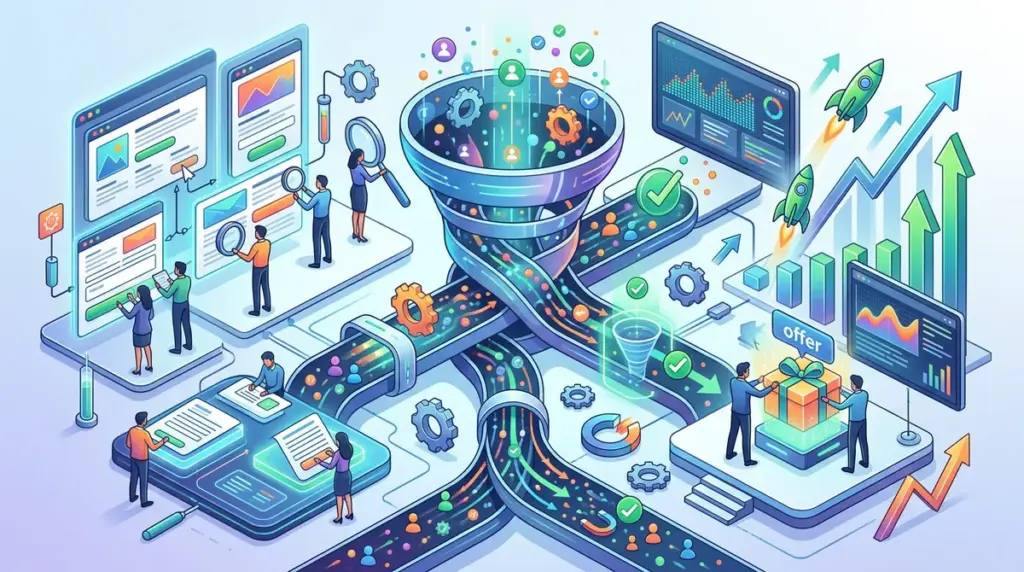
By 2026, the gap between teams that "run tests" and teams that "drive revenue" will be defined by how they handle the efficiency of their middle-of-funnel assets. Standard A/B testing on button colors is a legacy activity. Smart teams are now pivoting toward high-leverage architectural changes—dynamic form sequencing, zero-party data loops, and predictive layout validation—to combat rising customer acquisition costs (CAC). If your landing pages are still treating every visitor as a monolithic entity, you are overspending on traffic that will never convert.
Intent-Based Form Sequencing
Static multi-step forms are becoming a bottleneck. In 2026, the trend moves toward conditional logic that adjusts the friction level based on the user's perceived intent. If a visitor arrives from a high-intent bottom-of-funnel search term, the form should prioritize speed and direct contact. Conversely, if the traffic source is a broad social campaign, the form must pivot to an educational or qualifying sequence first.
Best for: B2B SaaS and high-ticket service providers looking to filter lead quality without dropping volume.
Instead of asking for a phone number on step one, smart sequences use "micro-commitments." Start with a low-friction question—like "What is your primary goal this quarter?"—to build momentum. Once the user has invested 15 seconds, they are statistically more likely to complete the higher-friction fields like company size or direct contact details. This approach turns a form into a conversation rather than an interrogation.
Dynamic Field Validation
Real-time validation is no longer just about checking if an "@" symbol exists in an email field. Advanced teams are integrating third-party APIs to validate company revenue, tech stack, or job titles in the background as the user types. This allows for real-time lead routing and personalized "Thank You" pages that offer specific calendar invites to high-value prospects while directing smaller leads to a self-serve demo.
Pro Tip: Never trigger error messages until a user has finished typing and moved to the next field. Premature validation creates "input anxiety," which causes a 5-10% drop-off in mobile users who are already struggling with small touch targets.
The Rise of Zero-Party Data Funnels
With the continued degradation of third-party cookies, conversion rate optimization is shifting into a data-collection discipline. Zero-party data—information that a customer intentionally and proactively shares with a brand—is the fuel for 2026 personalization strategies. Smart teams are building "choice-based" funnels where the user self-segments early in the journey.
Best for: E-commerce and D2C brands with diverse product catalogs.
- Interactive Quizzes: Moving beyond "find your style" to "diagnose your problem" funnels that provide immediate value.
- Preference Centers: Allowing users to dictate the frequency and content of follow-up sequences on the landing page itself.
- Segmented CTAs: Offering two distinct paths on a hero section (e.g., "I'm a Beginner" vs. "I'm an Expert") to serve tailored social proof and case studies.
Predictive Heatmapping and Pre-Launch Simulation
Waiting 14 days for an A/B test to reach statistical significance is a luxury many aggressive growth teams can no longer afford. In 2026, the standard workflow includes a pre-launch simulation phase. Using neural networks trained on millions of eye-tracking sessions, teams can predict with 90% accuracy where a user’s attention will land on a new design before a single dollar is spent on traffic.
This allows for rapid iteration on visual hierarchy. If the predictive model shows that users are ignoring the primary CTA in favor of a distracting background image, the design is fixed in the staging environment. This "pre-testing" ensures that live traffic is only used to validate the most refined versions of a page, significantly increasing the win rate of actual A/B tests.
Offer Stacking and Micro-Conversions
The "all-or-nothing" approach to conversion—where the only goal is a sale or a high-level lead—is failing. Smart teams are testing "offer stacks" that provide multiple exit points for different levels of readiness. If a user moves to exit a high-intent landing page, the exit-intent trigger shouldn't just be a generic discount. It should be a micro-conversion opportunity that keeps them in the ecosystem.
Best for: Long-cycle B2B and complex financial services.
For example, if the primary goal is a "Book a Consultation" (High Friction), the secondary offer might be a "10-Minute Video Audit" (Medium Friction), and the third might be a "One-Page Checklist" (Low Friction). By stacking these offers, you capture the 97% of traffic that isn't ready to buy today but will be in the next 90 days. This shifts the CRO focus from "conversion rate" to "pipeline contribution."
Friction-Based Segmentation
Sometimes, the goal isn't to remove friction, but to add it strategically. For high-volume accounts, adding a "qualification step" can actually increase the conversion rate of the most valuable leads by making the process feel more exclusive and tailored. In 2026, testing where to *add* friction to improve lead quality will be as common as testing where to remove it.
Operationalizing Your 2026 Testing Roadmap
To stay ahead, your team must move away from sporadic testing and toward a systematic "test-and-learn" engine. This requires a shift in how you allocate your CRO budget. Instead of spending 80% of your time on design and 20% on analysis, flip the script. Spend the majority of your energy on deep qualitative research—customer interviews, session recording audits, and heuristic evaluations—to ensure your tests are solving the right problems.
Start by auditing your highest-traffic landing pages for "intent-mismatch." Are you sending broad social traffic to a high-friction form? Are you sending high-intent search traffic to a long-form educational page? Fixing these structural misalignments will yield higher returns than any minor UI tweak. Prioritize tests that impact the entire funnel, not just a single page, and ensure every experiment has a clear hypothesis tied to a bottom-line business metric.
Frequently Asked Questions
How do we balance data collection with user privacy in 2026?
Focus on transparency and value exchange. Users are willing to share data if they understand how it improves their experience. Use "in-line" explanations for why you need specific information, such as "We ask for your industry to show you the most relevant case studies."
Is A/B testing still relevant with the rise of AI?
Yes, but the nature of the test has changed. AI is used to generate hypotheses and variations, but real-world user behavior remains the ultimate source of truth. Use AI to speed up the creative process, but use rigorous testing to validate the results.
What is the most important CRO metric to track now?
While conversion rate is the baseline, "Revenue Per Session" (RPS) or "Lead Value by Source" are more critical. A high conversion rate on low-quality leads is a net negative for the business. Track how your optimizations affect the total pipeline value, not just the number of form fills.