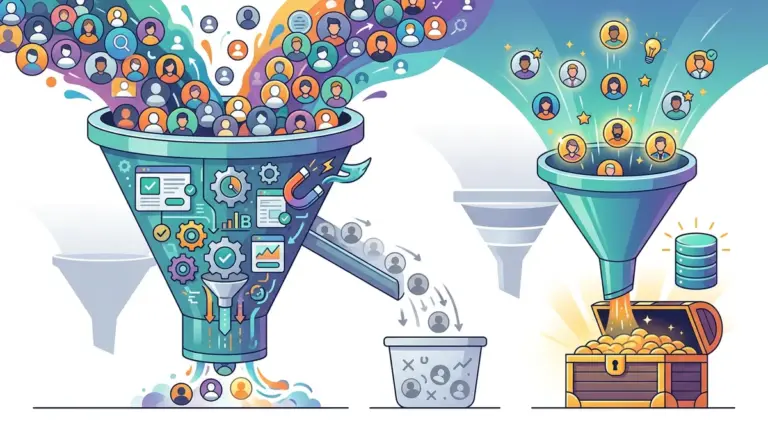
Most lead magnets fail because they are designed as bribes rather than bridges. When a visitor exchanges an email address for a generic "Ultimate Guide," they are often looking for a quick fix that doesn't actually align with your core product. This creates a database full of low-intent "freebie seekers" who never move toward a transaction. To drive actual conversion growth, a lead magnet must solve a specific, immediate problem that naturally leads to the next logical step in your sales funnel.
The Specificity Rule: Solving the "Problem-Solution Gap"
The most effective lead magnets target a micro-pain point within a larger business challenge. If you sell high-end SEO services, a "Complete Guide to SEO" is too broad; it attracts beginners who lack the budget for your services. Conversely, a "Google Search Console Audit Checklist for E-commerce Sites" attracts a sophisticated user who already has a site, understands the value of data, and is likely experiencing technical hurdles you can solve.
Best for: B2B service providers and SaaS companies looking to filter for high-intent prospects early in the journey.
To implement this, audit your current offer against the "One-Minute Value Test." If a user cannot derive a tangible benefit or a "win" within sixty seconds of opening your lead magnet, the friction of the opt-in will eventually lead to high unsubscribe rates and low brand trust. Focus on templates, calculators, or swipe files—assets that are consumed quickly and provide immediate utility.
Engineering Interactive Assets for Higher Retention
Static PDFs are increasingly ignored. Interactive lead magnets, such as ROI calculators, self-assessment quizzes, or pricing estimators, generate significantly higher engagement because they provide personalized data. When a user inputs their own numbers into a tool, they become psychologically invested in the outcome.
- Calculators: Build tools that quantify the cost of inaction. For a CRO agency, this might be a "Lost Revenue Calculator" based on current bounce rates and average order value.
- Audits/Quizzes: Use conditional logic to provide a custom score. This allows you to segment your email list automatically based on the user's specific needs or maturity level.
- Resource Libraries: Instead of one download, offer a gated "Vault" of assets. This increases the perceived value of the exchange and encourages repeat visits.
Pro Tip: Never use the "Thank You" page as a dead end. This is the moment of highest engagement. Instead of a simple confirmation message, embed a low-friction "Tripwire" offer or an invitation to a discovery call. You have already cleared the hurdle of the first "Yes"; use that momentum to move them toward a deeper commitment.
Form Optimization and Friction Management
The design of your capture form determines your Cost Per Lead (CPL). While marketing dogma suggests fewer fields lead to more conversions, this is only true for top-of-funnel awareness. For conversion growth, you need qualified leads, not just volume. Use multi-step forms to reduce cognitive load while still collecting deep data.
Start with a low-friction question that is easy to answer, such as "What is your primary business goal?" Once the user has clicked a button, they are more likely to complete the subsequent fields, including their email and phone number, due to the consistency principle. Ensure your form uses inline validation to prevent errors in real-time and utilizes "social proof" labels, such as "Join 5,000+ marketers," directly above the CTA button.
Technical Implementation and Tracking
A lead magnet is only as good as its delivery. Slow load times on landing pages or delayed automated emails will kill your conversion rate. Use a Content Delivery Network (CDN) for your assets to ensure instant downloads globally. From a tracking perspective, ensure you are firing a specific "Lead" event to your analytics platform and ad pixels (Meta, Google, LinkedIn) to optimize your bidding strategies for actual conversions rather than just page views.
Key Metric: Track the "Lead-to-MQL" (Marketing Qualified Lead) ratio. If you are getting thousands of downloads but zero sales conversations, your lead magnet is likely too broad or misaligned with your product's value proposition.
Maximizing Post-Conversion Velocity
The "Lead Magnet" is the start of the conversation, not the end. To ensure this lead turns into revenue, your automated follow-up sequence must be tightly coupled with the content they just downloaded. If they downloaded a "SaaS Churn Calculator," your first three emails should provide additional context on how to interpret those churn numbers and how your product directly addresses the variables in that calculator.
Avoid the "Newsletter Trap" where you immediately dump new leads into a generic weekly broadcast. Instead, use a dedicated 5-to-7 day "Indoctrination Sequence" that focuses exclusively on the problem solved by the lead magnet. This builds authority and keeps your brand top-of-mind during the critical window when the user is actively seeking a solution.
Audit and Iterate Your Lead Generation Framework
Conversion growth is an iterative process. To stay ahead of rising acquisition costs, you must constantly test the components of your offer. Start by testing the "Hook" (the headline of the lead magnet), then move to the "Format" (PDF vs. Video vs. Tool), and finally optimize the "Friction" (the number of form fields). Use A/B testing tools to run these experiments simultaneously to ensure statistical significance before rolling out changes across your entire site.
Review your lead magnet performance every quarter. Markets shift, and what was a "hot" topic last year—such as generic "AI tips"—may now be considered noise. Update your assets with fresh data, new case studies, and modern UI to maintain high conversion rates and ensure your funnel remains a predictable source of revenue.
Lead Magnet Strategy FAQ
Should I gate all of my best content?
No. Use the "10/90 Rule." Give away 90% of your insights for free to build SEO authority and trust. Gate the final 10%—the specific "how-to" templates, tools, or proprietary data—that allows the user to implement those insights. Gating everything creates a barrier to entry that can hurt your brand's reach.
What is a good conversion rate for a lead magnet landing page?
While industry averages vary, a high-intent, targeted landing page should aim for 20% to 40%. If you are below 10%, there is likely a "Message-to-Market" mismatch, meaning your ad or CTA is promising something the landing page isn't delivering, or the offer itself isn't compelling enough for the target audience.
How long should my lead magnet be?
Length is less important than "Time to Value." A one-page cheat sheet that saves a manager three hours of work is infinitely more valuable than a 50-page ebook that requires four hours to read. Focus on brevity and actionable steps. If it takes more than 10 minutes to consume, you are likely losing the user's attention before you can make your next offer.