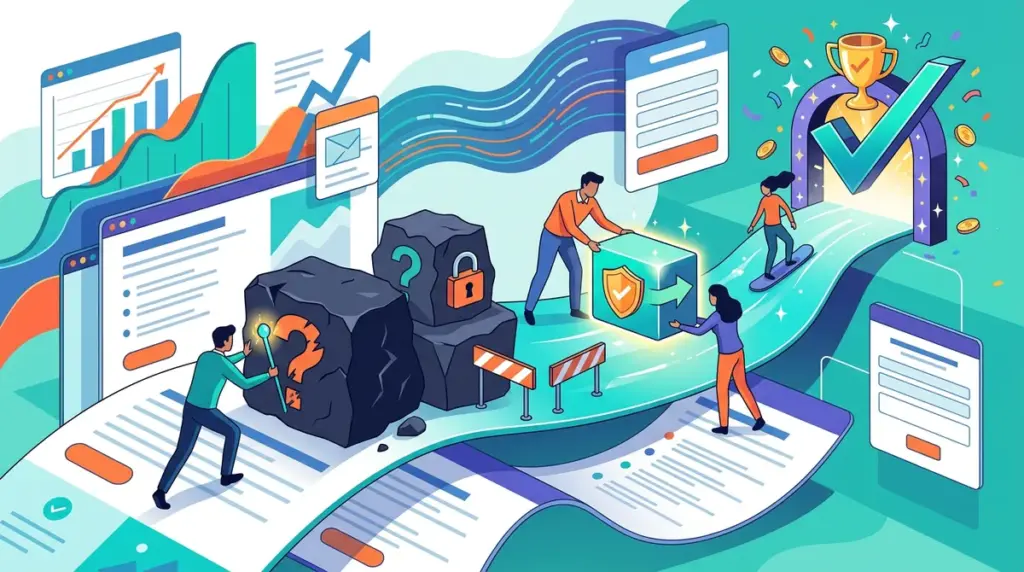
Most landing pages fail not because the offer is weak, but because the copy ignores the silent "No" happening in the visitor's mind. Every click toward a conversion is a micro-negotiation. The visitor brings a lifetime of skepticism, past product failures, and budget anxieties to your page. If your copy only focuses on the "sunny day" scenario of how life looks after the purchase, you leave the heavy lifting of risk assessment to the user. They will almost always choose the safety of doing nothing. This is why mastering the art of writing website copy that converts is so vital for any business aiming for online success.
Effective objection handling in landing page copy isn't about being defensive; it is about proactive friction removal. It requires identifying the specific reasons a qualified lead might hesitate and dismantling those barriers before they reach the call to action (CTA). To truly convert, your copy must guide visitors smoothly toward that final step, perhaps by using powerful call to action examples.
Identifying the Friction Points in Your Funnel
You cannot guess what your customers are afraid of. Effective objection handling requires data-backed insights into why people abandon your page. Generic rebuttals like "It's easy to use" are often ignored because they lack the specificity required to build trust.
Mining Customer Support and Sales Logs
The most potent copy on your landing page often exists inside your support tickets or CRM notes. Look for recurring questions that start with "Does it work with..." or "What happens if..." These are not just questions; they are the exact barriers preventing a conversion. If three people ask about a specific integration in a week, three hundred people likely wondered the same thing and left the page because the answer wasn't visible.
Utilizing Post-Purchase Surveys
Ask your recent converts: "What was your biggest hesitation before signing up?" This identifies the "last mile" objections. Common answers include concerns about the learning curve, hidden costs, or the difficulty of switching from a competitor. Use these verbatim phrases in your headers to create an immediate sense of being understood.
The Four Pillars of Landing Page Objections
While every niche has unique nuances, most objections fall into four primary categories. Addressing these systematically ensures your copy covers the full spectrum of buyer hesitation.
- Price and Value: The fear that the ROI won't justify the cost or that there are hidden fees.
- Implementation and Effort: The "I don't have time for this" objection. This covers setup time, learning curves, and technical requirements.
- Trust and Risk: The fear of looking foolish to a boss or losing money on a product that doesn't work.
- Efficacy and Fit: The doubt that the solution works for their specific industry, scale, or use case.
Warning: Be careful not to introduce "phantom objections." If your data shows that users aren't worried about security, don't dedicate a massive section to it. Highlighting a non-existent concern can actually trigger new anxieties and lower conversion rates.
Strategic Placement of Rebuttals
Where you handle an objection is as important as how you handle it. Timing is everything in a digital sales pitch. If you address price before you have established value, you look expensive. If you address technical specs too late, the user has already checked out.
The "Click-Trigger" Micro-Copy
The area immediately surrounding your CTA button is high-stakes real estate. This is where "Last-Second Friction" occurs. Use micro-copy to neutralize the final doubt.
Best for: Reducing abandonment on high-intent forms.
Example: Under a "Start Free Trial" button, add "No credit card required. Takes 30 seconds." This addresses both the risk (credit card) and the effort (time) objections in one sentence.
The Comparison Table as an Objection Killer
If your prospect is considering a competitor, they are currently tab-switching. Bring that comparison onto your page. A specific, honest comparison table doesn't just show features; it handles the "Why you instead of them?" objection. Avoid the "all green checks for us, all red Xs for them" cliché. Acknowledging a competitor's strength in a specific, non-core area actually increases your credibility when you claim superiority in your primary value prop.
Dismantling the "Too Much Effort" Barrier
In B2B and SaaS, the fear of a grueling implementation process kills more deals than price. To handle this, your copy must move from abstract promises to concrete timelines. Instead of saying "Quick setup," use "Go live in under 15 minutes with our 3-step onboarding wizard."
Use "Social Proof of Ease" to reinforce this. A testimonial that says "I'm not tech-savvy, but I had this running by lunch" is worth more than a thousand words of marketing copy. It targets the specific psychological fear of personal inadequacy or technical frustration.
Risk Reversal Beyond the Money-Back Guarantee
A standard 30-day guarantee is the bare minimum. To truly handle risk-based objections, you need to offer "Loss Aversion" copy. This means explaining what happens if the product fails. Do you offer a migration service to move their data back out? Is there a dedicated success manager? For high-ticket services, risk is often professional, not just financial. The buyer is worried about their reputation within their company. Address this by providing "internal sell-in" kits or ROI calculators they can present to stakeholders.
Deploying a Dynamic FAQ Section
The FAQ section should not be a junk drawer for miscellaneous info. It should be a curated list of the top five reasons people don't buy, flipped into informative answers. Use accordion styles to keep the page clean, but ensure the questions themselves are written from the customer's perspective. Use "I" statements: "How do I know if my team will actually use this?" rather than "User Adoption Rates."
Audit and Refine Your Friction Points
Objection handling is not a "set it and forget it" task. As markets mature and competitors shift their messaging, your customers' fears will evolve. To maintain a high-converting landing page, follow this iterative process:
Step 1: Run a heatmap tool to see where users linger. If they spend a long time on the pricing section but don't click, your value-to-price ratio isn't clear enough.
Step 2: Interview your sales team monthly. Ask them what the "deal-breakers" were for the leads that didn't close. These are your new H2s for the next landing page variant.
Step 3: A/B test your rebuttals. Test a "Time-Saving" objection handler against a "Risk-Reduction" handler to see which primary fear is driving the most resistance in your current audience.
Frequently Asked Questions
How many objections should I address on one page?
Focus on the top 3 to 5 most common hurdles. Attempting to answer every possible edge case leads to "wall of text" syndrome, which creates its own form of friction and makes you look defensive.
Should I mention competitors by name when handling objections?
Yes, if your data shows that your target audience is actively comparing you to a specific incumbent. Addressing a competitor directly allows you to control the narrative of the comparison rather than leaving it to the visitor's imagination.
Does objection handling work for low-cost B2C products?
Absolutely. Even for a $20 item, the objection might be "Will this arrive on time?" or "Is the return process a nightmare?" Handling these simple logistical fears can significantly lift conversion rates in e-commerce.
What is the best way to handle the "It's too expensive" objection?
Shift the conversation from "cost" to "cost of inaction." Contrast the price of your solution against the measurable financial loss, wasted time, or missed opportunities the customer faces by staying with their current, flawed process.