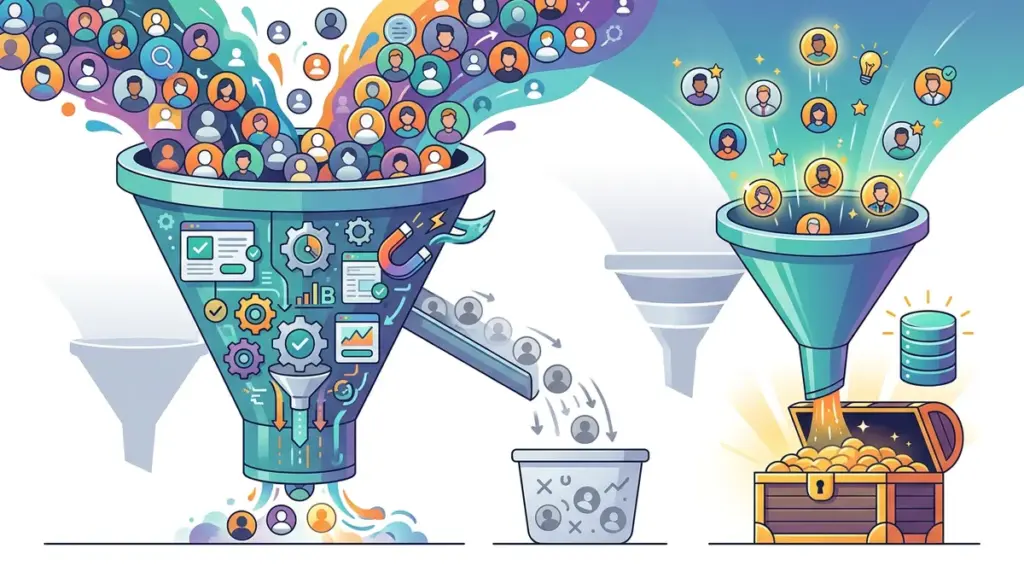
Scaling a lead generation campaign often triggers a law of diminishing returns: as the monthly spend climbs, the cost-per-acquisition (CPA) might remain stable, but the sales team begins complaining about "junk" leads. The typical response is to either tighten the targeting—which kills volume—or loosen the form requirements—which kills quality. This binary choice is a failure of funnel architecture.
To increase volume while simultaneously improving lead quality, you must move away from generic "Contact Us" or "Free Ebook" offers. You need a system that uses strategic friction to filter out tire-kickers while using high-value interactive assets to pull in high-intent buyers who would otherwise ignore a standard sales pitch.
Designing Intent-Driven Friction into Landing Pages
The biggest mistake in CRO is the obsession with removing all friction. While reducing form fields can increase the raw number of submissions, it often dilutes the data your sales team needs to prioritize their day. Instead of removing friction, you must redirect it.
Best for: B2B SaaS, high-ticket service providers, and agencies with limited sales capacity.
Multi-step forms outperform long, single-page forms because they leverage the "sunk cost" effect. When a user answers three low-stakes questions (e.g., "What is your primary goal?"), they are statistically more likely to provide their email and phone number on the final step to "see their results." This structure allows you to ask qualifying questions—like annual revenue or team size—early in the process. If a lead doesn't meet your minimum threshold, you can route them to a resource page rather than your sales team’s calendar.
Implementing Conditional Logic for Real-Time Qualification
Static forms are blind. Modern landing pages should use conditional logic to change the user’s path based on their inputs. If a lead selects a budget under $5,000, the form should not offer a "Book a Call" option. Instead, it should offer a pre-recorded demo or a whitepaper. This protects your sales team’s time (maintaining quality) while still capturing the lead for a lower-touch nurturing sequence (maintaining volume).
- Segment by Intent: Ask "How soon are you looking to start?" Leads answering "Immediately" get a direct call-to-action; others get educational content.
- Dynamic Redirects: Send high-value leads to a Calendly embed immediately after submission.
- Field Validation: Use third-party APIs to block free email providers (Gmail, Yahoo) if your ideal customer profile (ICP) is strictly corporate.
The Shift from Passive Content to Interactive Diagnostic Tools
Generic lead magnets like PDFs are losing their efficacy. They are passive, often left unread in a "Downloads" folder, and provide no data back to the marketer about the lead's specific pain points. To increase volume, you need an offer that provides immediate, personalized value.
Interactive tools—such as ROI calculators, gap analyses, or maturity assessments—convert at significantly higher rates because they solve a specific problem in real-time. For the marketer, these tools are gold mines. Every button a user clicks is a data point that enriches the lead profile before the first sales call even happens.
Warning: Never gate an interactive tool at the very beginning. Allow the user to engage with the tool and see partial results first. Gating the final "Full Report" or "Detailed Analysis" ensures the lead is already invested in the outcome, leading to a 30-50% higher conversion rate compared to a front-gated landing page.
Leveraging Data Enrichment to Shorten Forms
There is a direct inverse correlation between the number of form fields and the conversion rate. However, your CRM needs more than just a name and email. Data enrichment tools allow you to have the best of both worlds: a short, high-converting form and a deep, high-quality lead profile.
By using tools that hook into the email field or IP address, you can automatically append company name, industry, headcount, and even tech stack to the lead record in the background. This allows you to keep your public-facing form down to 2 or 3 fields, which maximizes volume, while the enriched data ensures the sales team only spends time on leads that fit the ICP.
Optimizing Ad Creative for Pre-Qualification
Lead quality doesn't start on the landing page; it starts in the ad copy. If your ads are too "clickbaity" or focus solely on a free giveaway, you will attract a high volume of low-intent traffic. To improve quality at the source, your ad creative should explicitly mention who the offer is for—and who it isn't for.
Include "call-outs" such as "For Marketing Teams of 10+" or "Designed for Series A Founders." While this may lower your Click-Through Rate (CTR), it significantly increases your Lead-to-Opportunity conversion rate. You are effectively paying for fewer, better clicks, which prevents your funnel from being clogged with noise.
Operationalizing the Quality-Volume Balance
To maintain this balance over time, you must establish a feedback loop between marketing and sales. This isn't about "vibes"; it's about hard data. Track the "Lead-to-SQL" (Sales Qualified Lead) ratio weekly. If volume is up but the SQL ratio is down, it’s time to add a qualifying question to your multi-step form or tighten your ad targeting parameters.
Conversely, if the SQL ratio is 90% but the sales team is sitting idle, you have too much friction. You should test removing the most "difficult" qualifying question or broadening your top-of-funnel ad audiences to bring in more raw volume for the system to filter.
Common Challenges in Lead Optimization
How do I know if my form has too much friction?
Monitor your form abandonment rate at each step. If you see a 70% drop-off on a specific question, that question is either too intrusive or poorly phrased. Test moving it later in the sequence or making it optional to see if volume recovers without sacrificing the data you need.
Will adding a phone number field always kill my conversion rate?
Usually, yes—by as much as 25-40%. Only require a phone number if your sales process requires an immediate outbound call. If you follow up via email or LinkedIn, make the phone number optional. If you must have it, place it on the final step of a multi-step form to capitalize on the momentum the user has already built.
What is the best way to handle "junk" leads that still convert?
Do not delete them. Route them to an automated email nurture sequence or a low-cost "self-service" version of your product. This keeps your main sales pipeline clean while ensuring you aren't wasting the ad spend used to acquire those users. They may not be a fit today, but they might be in twelve months.
Should I use CAPTCHA to improve lead quality?
Only as a last resort. Visible CAPTCHAs are conversion killers. Instead, use "honeypot" fields (hidden fields that only bots fill out) or invisible reCAPTCHA. Improving quality should focus on human intent, not just filtering out bot spam.