

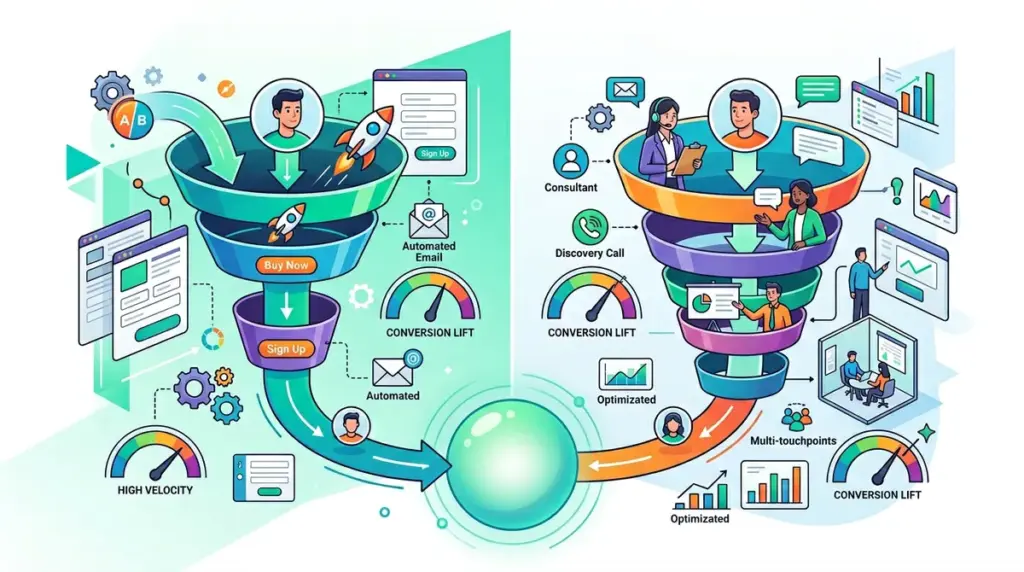
The decision to deploy a self-serve motion versus a sales-led funnel is rarely a matter of preference; it is a calculation of Customer Acquisition Cost (CAC) relative to Annual Contract Value (ACV). For a $20/month SaaS, a sales-led model is a fast track to bankruptcy. For a $50,000 enterprise solution, a self-serve "Buy Now" button is a conversion killer that fails to address the complex procurement and security requirements of the buyer. From a conversion rate optimization (CRO) perspective, these two funnels require diametrically opposed tactics to move a user from visitor to customer.
The Unit Economics of Intentional Friction
In a self-serve environment, friction is the enemy. Every additional form field, forced email verification, or multi-step onboarding screen represents a drop-off point. The goal is to shrink the "Time to Value" (TTV) to as close to zero as possible. If a user can experience the core utility of the product within the first 90 seconds, the likelihood of retention increases significantly.
Conversely, sales-led funnels utilize friction as a qualifying filter. If your sales team is spending 30 minutes on a discovery call with a lead who has a $50 budget, your funnel has failed. In this context, CRO is not about maximizing the total number of leads, but about maximizing the volume of Sales Qualified Leads (SQLs). Adding fields like "Annual Revenue" or "Current Tech Stack" to a demo request form might lower your total conversion rate by 15%, but if it increases the lead-to-opportunity rate by 40%, the funnel is objectively more efficient.
Conversion Triggers in Self-Serve PLG Environments
Product-Led Growth (PLG) relies on the product to do the heavy lifting of the sale. The landing page's primary job is to sell the "Free Trial" or "Freemium" tier. To optimize these pages, focus on these specific levers:
- The "Aha!" Moment Preview: Instead of static screenshots, use high-fidelity interactive loops or "sandbox" previews that allow users to see the output of the tool before they even create an account.
- Template Libraries: For tools like Notion or Canva, the conversion trigger isn't the software itself, but the immediate solution to a problem. Landing pages should drive traffic directly into specific templates to bypass the "blank canvas" anxiety.
- Social Proof for the Individual Contributor: While enterprise pages need logos of Fortune 500 companies, self-serve pages need testimonials from peers. A developer wants to know that another developer found the API documentation easy to use.
Warning: Beware of "Empty State" churn. Many self-serve funnels convert the sign-up but fail at the first login. If your user lands in a dashboard with zero data and no clear next step, your conversion efforts are wasted. Use progress bars and "Quick Start" checklists to maintain momentum.
Optimizing the Sales-Led Demo Request
When the goal is a high-ticket contract, the landing page must build massive authority and trust. The "Request a Demo" page is the most critical asset in this funnel. To increase the conversion rate of high-value prospects, consider the following technical adjustments:
Immediate Scheduling: The traditional "we will contact you within 24 hours" model is a conversion leak. Integrating tools like Calendly or Chili Piper directly into the form submission success state can increase "show-up" rates by over 30%. The moment of highest intent is immediately after the form is filled; capitalize on it by letting them book the meeting instantly.
Dynamic Form Length: Use clearbit or similar enrichment tools to shorten forms. If you can identify a visitor's company and size via their IP or email domain, do not ask them for that information. A three-field form (Work Email, Name, and "What is your biggest challenge?") will always outperform a ten-field form, provided you have the backend data to fill the gaps for your sales team.
The Role of Social Proof in Enterprise Decisions
In a sales-led model, the buyer is often not the end-user. The buyer is a manager or executive concerned with ROI, security, and implementation. Your CRO assets should include:
G2/Capterra Grid Placements: Highlighting your position as a "Leader" in a specific category provides third-party validation that reduces the perceived risk of a large purchase.
Security Badges: SOC2 Type II, GDPR compliance, and HIPAA badges are not just "legal fluff"—they are conversion assets that prevent the deal from stalling at the procurement phase.
The Hybrid Approach: Product-Led Sales
The most sophisticated organizations are moving toward a "Product-Led Sales" model. This involves a self-serve entry point where users can start for free, but once they hit certain "usage triggers"—such as adding five team members or reaching a specific data threshold—the funnel shifts to sales-led. This requires a different set of CRO goals:
PQL Identification: A Product Qualified Lead (PQL) is a user who has signaled intent through product usage. Your CRO strategy here focuses on "in-app" conversion points, such as gated features that require a "Talk to Sales" conversation to unlock. These triggers must be placed exactly where the user feels the limitation of the free tier, not randomly throughout the UI.
Auditing the Funnel for Maximum Yield
To determine where your conversion leaks are occurring, you must map your metrics to the funnel type. For self-serve, track the conversion from Visitor -> Sign-up -> Active User. If the drop-off is between Sign-up and Active User, your onboarding is the problem, not your landing page. For sales-led, track Visitor -> Form Submission -> Discovery Call -> Closed Won. If you have high submissions but low discovery calls, your qualifying questions are likely too weak or your follow-up time is too slow.
Test one variable at a time. On a demo page, test the CTA copy (e.g., "See the Platform" vs. "Get a Custom Quote"). In a self-serve flow, test the friction of the sign-up process (e.g., Google Auth vs. Email/Password). Every change should be backed by a hypothesis regarding the user's psychological state at that specific stage of the journey.
Frequently Asked Questions
Should I offer a free trial or a demo for a $5,000/year product?
At the $5k/year price point, you are in the "No Man's Land" of SaaS. If your product is "plug and play," a free trial (self-serve) is usually better. If it requires complex integration or data migration, a guided demo (sales-led) is necessary to ensure the user sees the value before they give up.
How many fields should my "Request a Demo" form have?
Only as many as your sales team actually uses to route the lead. If your AEs don't use the "Phone Number" field to call leads immediately, remove it. Every field added to a form typically decreases conversion by 3-5%.
What is the best CTA for a self-serve landing page?
"Start for Free" or "Get Started" generally outperforms "Sign Up Now" because it emphasizes the benefit (starting) rather than the effort (signing up). Always test CTAs that imply immediate access to the solution.
How do I handle "tire-kickers" in a sales-led funnel?
Use a qualifying checkbox or dropdown on your form that asks for their budget or team size. You can then use logic to send low-budget leads to a recorded demo video or a self-serve "starter" plan, while high-value leads are sent to a live calendar to book a meeting.