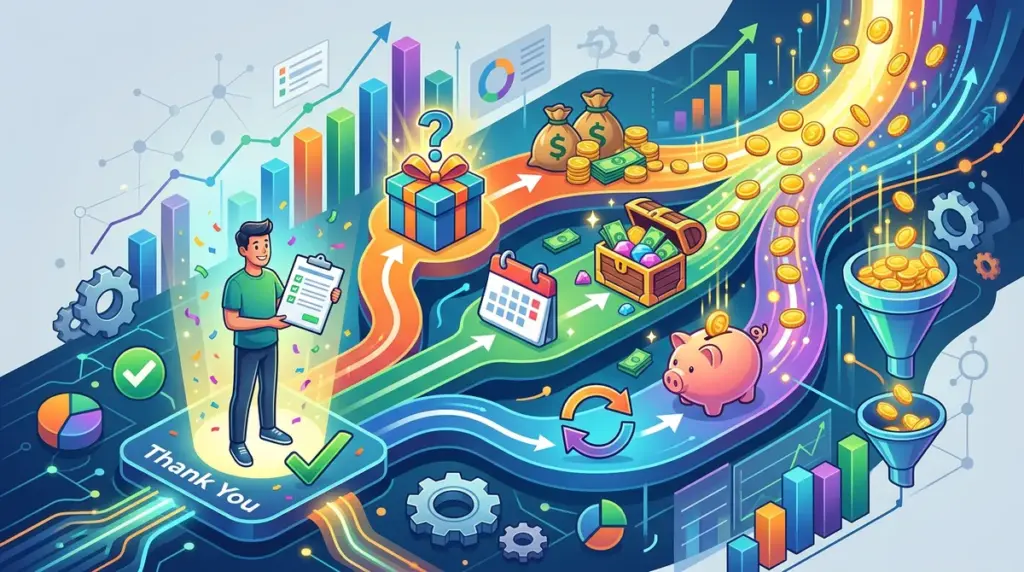
Most marketers treat the "Thank You" page as a digital dead end—a polite confirmation that the transaction or lead capture is complete. This is a fundamental waste of the highest-intent moment in the customer journey. When a user reaches this page, they have already bypassed their natural resistance to your brand, shared their data, or committed their capital. They are in a state of compliance. By failing to offer a logical next step, you are effectively telling a hot lead to go away exactly when they are most likely to say "yes" again.
Optimizing this real estate isn't about being pushy; it is about maintaining momentum. If your conversion path stops at a generic "we will be in touch," you are leaving revenue on the table that could be captured through immediate upsells, lead enrichment, or referral loops.
The Psychology of Post-Conversion Momentum
The moment after a conversion is characterized by a "dopamine spike." Whether they just downloaded a whitepaper or bought a pair of shoes, the user feels a sense of accomplishment. Cognitive dissonance is at its lowest. In B2B, this is the window to ask for deeper qualification data. In e-commerce, this is the window for the "impulse upsell."
Best for: High-volume lead gen sites and e-commerce stores with a clear product hierarchy.
To capitalize on this, you must move beyond the confirmation message. The goal is to transition the user from a "completed state" back into an "active state." This is achieved by providing a secondary offer that complements the primary action they just took. If they signed up for a newsletter, offer a low-cost "tripwire" product. If they bought a product, offer a discounted subscription or a complementary accessory.
The Tripwire Offer: Converting Leads into Multi-Buyers
A tripwire is a low-friction, high-value offer designed specifically to turn a lead into a customer immediately. The price point is usually between $7 and $49—low enough that it doesn't require a board meeting or a spouse's approval, but high enough to establish a financial relationship.
For a tripwire to work on a Thank You page, it must be hyper-relevant. If the user just downloaded a guide on "SEO Audits," the Thank You page should offer a "$27 SEO Audit Template Kit." This works because it solves the "now what?" problem. They have the knowledge (the guide); now they need the tools (the kit).
- Urgency: Use a countdown timer for a "one-time offer" (OTO) available only on that page.
- Simplicity: Do not introduce a complex new sales pitch. Use a single-column layout with a clear "Add to Order" or "Buy Now" button.
- Risk Reversal: Mention a 30-day money-back guarantee to eliminate the last bit of friction.
Pro Tip: Never use a generic "Shop All" button on a Thank You page. Choice overload kills momentum. Present one specific, logical next step that requires a simple yes/no decision.
Progressive Profiling to Shorten the Sales Cycle
In B2B lead generation, the biggest friction point is the length of the initial form. You want to ask 10 questions to qualify the lead, but you know that every extra field drops the conversion rate. The Thank You page solves this via progressive profiling.
Keep your initial landing page form short (Name, Email, Company). Once they hit the Thank You page, present a secondary form or a short survey. Frame it as a way to "customize their experience" or "get more relevant content."
Specific data points to collect:
1. Budget range (to prioritize sales outreach).
2. Timeline for implementation.
3. Current pain points or specific tools they use.
4. Decision-making authority.
By moving these fields to the Thank You page, you ensure you get the lead first. Even if they don't fill out the second form, you still have their email. If they do fill it out, your sales team receives a highly qualified profile, allowing them to skip the discovery phase and move straight to the pitch.
Incentivized Referrals and Viral Loops
The Thank You page is the optimal place to launch a referral program. The user is currently happy with their decision to engage with you. Asking them to share your brand with a colleague or friend at this moment feels like a recommendation, not an advertisement.
Instead of a generic social sharing button, use a "referral for reward" system. For example, "Invite 3 friends to get this $50 course for free" or "Give your friends $20 off, and get $20 for yourself." This creates a viral loop where one acquisition leads to multiple potential leads at zero additional CAC (Customer Acquisition Cost).
Best for: SaaS platforms, newsletters, and subscription boxes where the lifetime value (LTV) justifies the referral payout.
Technical Requirements for Accurate Attribution
None of these strategies matter if your tracking is broken. A common mistake is failing to exclude the Thank You page from search engine indexing, leading to "ghost conversions" in Google Analytics when users find the page via search. Always set the page to noindex, nofollow.
Furthermore, ensure your conversion pixels (Meta, LinkedIn, Google Ads) fire only once per unique transaction. If a user refreshes the Thank You page, you don't want your ad platform reporting two sales. Use a unique transaction ID in your data layer to deduplicate these events. If you are running an upsell on the Thank You page, you need a separate "Upsell Success" event to track the incremental lift specifically from that page.
Audit Your Post-Conversion Workflow
To start generating more revenue from your Thank You pages today, follow this audit checklist:
1. Identify the "Dead Ends": Look at your top-performing landing pages. Does the journey stop at the confirmation message? If so, that is your first priority for an OTO or survey.
2. Test One Variable: Do not overhaul everything at once. Start by adding a single low-friction offer or a "Book a Demo" calendar embed. Measure the take rate over 30 days.
3. Check Mobile Layout: Many Thank You pages are neglected in mobile design. Ensure your upsell buttons are thumb-friendly and the text is legible without zooming.
4. Match the Tone: The transition from the landing page to the Thank You page should be seamless. Use the same branding, fonts, and voice to maintain trust during the "second sale."
Frequently Asked Questions
Should I put a video on my Thank You page?
Yes, if it serves a specific purpose. A short (under 60 seconds) video thanking the user and explaining the "one-time offer" can significantly increase upsell conversion rates by adding a human element and reducing perceived risk.
Will an upsell on the Thank You page annoy my customers?
Not if it is relevant. If the offer solves a problem related to their initial purchase, it is seen as a helpful recommendation. It only becomes annoying when the offer is unrelated or requires a complex checkout process.
What is a good conversion rate for a Thank You page upsell?
For B2B lead enrichment surveys, expect a 15-30% completion rate. For e-commerce tripwires, a 3-7% conversion rate is considered strong, as this represents purely incremental revenue from users who were otherwise finished shopping.