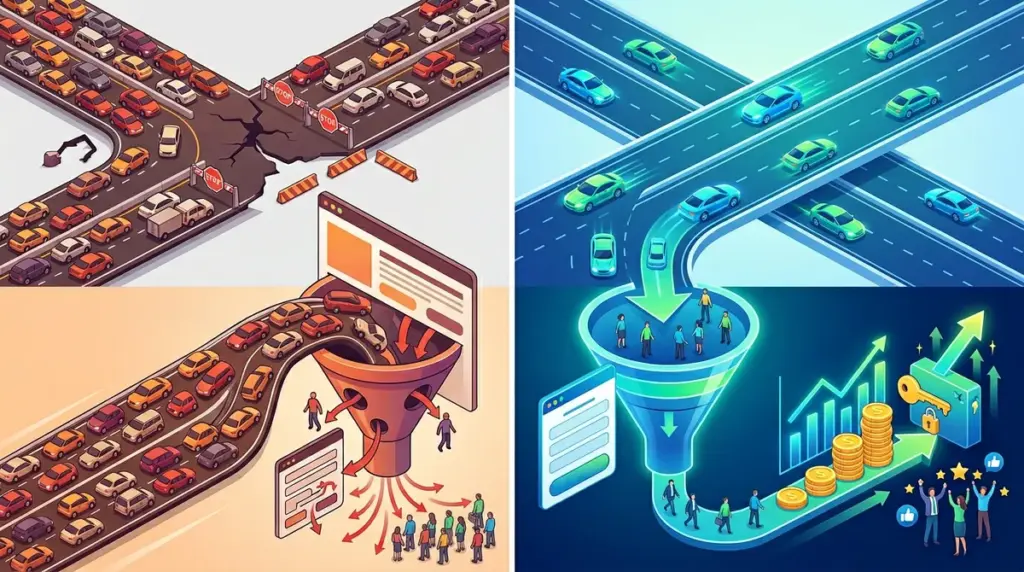
Most marketing post-mortems fail because they misdiagnose the bottleneck. When revenue stalls, the default reaction is usually to "get more eyeballs" through increased ad spend or aggressive SEO. However, pouring more fuel into a car with a broken transmission won't make it go faster; it just wastes gas. Distinguishing between a traffic problem and a conversion problem is the difference between scaling a profitable engine and subsidizing a leaky bucket.
The Anatomy of a Traffic Problem
A traffic problem exists when you have a proven offer and a high-converting landing page, but the volume of qualified users is too low to hit revenue targets. This is a top-of-funnel issue. You can identify a traffic problem by looking at your conversion rate (CVR) relative to industry benchmarks. If your page converts at 5% or 10% but you only see 200 visitors a month, your bottleneck is reach, not persuasion.
Primary Indicators of Traffic Deficits:
- High conversion rates but low absolute lead volume.
- Low search volume for target keywords (market saturation).
- High Impression Share but low Click-Through Rate (CTR) on ads or SERPs.
- Stagnant month-over-month growth in unique sessions despite consistent content output.
Fixing a traffic problem requires diversifying channels or deepening penetration in existing ones. If organic search is tapped out, the solution is often moving into paid social or YouTube to generate demand rather than just capturing it. If your CTR is low, the problem is your "hook"—the meta description or ad copy isn't compelling enough to earn the click.
The Friction Points of a Conversion Crisis
A conversion problem is far more common and significantly more expensive. This occurs when you are successfully driving users to your site, but they are exiting without taking the desired action. This is a middle- or bottom-of-funnel failure. If you are spending $10,000 a month on Google Ads and seeing a 0.5% conversion rate on a standard lead-gen form, you don't have a traffic problem; you have a friction problem.
Conversion problems are usually rooted in one of three areas: technical friction, lack of trust, or offer misalignment. Technical friction includes slow load times or broken mobile layouts. Trust issues stem from poor design or missing social proof. Offer misalignment is the most lethal; it happens when what you promised in the ad doesn't match what is on the page.
Warning: Scaling spend on a conversion-deficient funnel is the fastest way to liquidate your marketing budget. Before increasing daily ad spend by even 10%, verify that your "Add to Cart" or "Form Submission" rate is stable across different device types.
Intent-Offer Mismatch: The Invisible Killer
Sometimes the line between traffic and conversion blurs. This happens when you have "bad traffic." You might be ranking for high-volume keywords, but if those keywords carry "informational" intent (users looking for a definition) and you are serving a "transactional" offer (a $5,000 service), the users will bounce. This looks like a conversion problem because the CVR is low, but it is actually a traffic quality problem.
Best for diagnosing intent: Review your search terms report in Google Ads or Search Console. If users are finding your "Book a Demo" page by searching for "free templates," your traffic is mismatched. You are bringing the wrong people to the right party.
The Math of the Pivot
To decide where to focus your resources, calculate your Revenue Per Session (RPS). If your RPS is high but your volume is low, buy more traffic. If your volume is high but your RPS is lower than your Cost Per Acquisition (CPA), stop buying traffic and start testing your landing pages.
Consider a scenario where you have 5,000 monthly visitors and a 1% conversion rate, yielding 50 leads.
Option A: Double your traffic to 10,000 visitors (Cost: Likely double your current spend).
Option B: Optimize the page to move the conversion rate from 1% to 2% (Cost: One-time CRO project).
Option B yields the same 100 leads but effectively cuts your CPA in half forever. In a competitive landscape, the brand that can afford to pay the most for a customer wins. By solving the conversion problem first, you increase your "allowable CPA," which then allows you to outbid competitors for the best traffic.
Identifying Friction in the User Journey
If you suspect a conversion problem, look at your "drop-off" points. Use heatmaps and session recordings to see where users stop scrolling.
Common friction points include:
- The Hero Section: If users bounce within 3 seconds, your value proposition is unclear.
- Form Length: Every unnecessary field in a contact form can reduce conversions by 5-10%.
- Social Proof Placement: If your testimonials are at the bottom of a long page, nobody is seeing them.
- Mobile Responsiveness: A "sticky" CTA that works on desktop but covers the text on mobile is a conversion killer.
Prioritizing Your Next Growth Lever
Stop looking at "traffic" as a monolithic metric. Segment your data by source and landing page. If your Facebook traffic converts at 3% but your organic search traffic converts at 0.5%, you don't need a "site-wide" CRO fix; you need to investigate why your SEO content isn't leading to a sale. It might be that your blog posts lack clear calls-to-action or that the content is too top-of-funnel.
The most efficient growth strategy is to fix the conversion rate of your highest-volume pages first. Even a 0.2% lift on a page receiving 50,000 hits a month results in a massive revenue shift. Once the page is "hardened" and converting efficiently, you can then aggressively scale your traffic acquisition through paid channels with the confidence that you aren't burning cash.
Frequently Asked Questions
How do I know if my conversion rate is actually "bad"?
Compare your CVR against your specific industry average, but more importantly, compare it against your break-even point. If your CVR doesn't allow for a profitable CPA, it is "bad" regardless of industry benchmarks.
Can a traffic problem cause a conversion problem?
Yes. If you target broad, low-intent keywords to inflate traffic numbers, your conversion rate will naturally plummet because the audience isn't ready to buy. This is a quality issue, not a page design issue.
Should I fix traffic or conversion first?
Always fix conversion first if you have at least 500-1,000 visitors a month. You need a baseline of data to test. If you have zero traffic, you must solve the traffic problem first just to get the data required for CRO.
What is the fastest way to fix a conversion problem?
The fastest "win" is usually improving the "Headline" and the "Offer." If the offer is compelling (e.g., a "Free Audit" vs. "Contact Us"), users will often overlook minor design flaws or long forms.